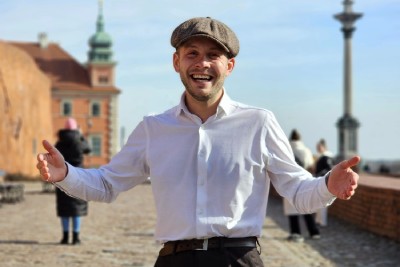
Step back in time with me on a moving and insightful tour of the Warsaw Ghetto.
As we walk through the streets where history unfolded, I’ll share powerful stories of resilience, courage, and tragedy from the city’s darkest chapter. With my engaging storytelling, you’ll gain a deep understanding of the events that shaped the city and the unforgettable heroes who fought for survival. This tour is not just about learning history—it’s about honoring the past and reflecting on its significance today.
Highlights
Grzybowski Square, Nożyk Synagogue, original Ghetto wall, pre-WWII residential buildings, Chłodna Footbridge monument, Ghetto Heroes Monument, Polin Museum, – all viewed from the outside.
Language
English
Tour Duration
Up to 2,5 hours
Price
900 PLN
Tour of the Warsaw Ghetto
Step back in time and join a moving and educational tour of the Warsaw Ghetto. As we walk the streets where history unfolded, I will share powerful stories of courage and perseverance from the darkest chapter in the city’s past. Through my engaging narration, you will come to understand the events that shaped the city — and the unforgettable heroes who fought to survive. This tour isn’t just about learning history — it’s about honoring the past and reflecting on its meaning.
- Tour of the Warsaw Ghetto
- Walking Tour of Warsaw — Grzybowski Square
- The Zalman and Rywka Nożyk Synagogue
- Where Can You See Other Ghetto Wall Fragments?
- Prewar Residential Buildings
- The Chłodna Footbridge Memorial — Where the Wooden Bridge Once Connected the Two Ghettos
- The Ghetto Heroes Monument and POLIN Museum
Highlights: Grzybowski Square, Nożyk Synagogue, original ghetto wall, prewar residential buildings, the Chłodna Footbridge Monument, the Ghetto Heroes Monument, POLIN Museum — all viewed from the outside..
Tour duration: up to 2.5 hours.
When the Germans created the Jewish district in Warsaw in 1940, no one in the city could have foreseen how tragically the lives of the Jews living in the ghetto would end. The district was divided into the large and small ghettos. The large ghetto covered Muranów and the western part of Śródmieście, while the small ghetto began on the other side of Chłodna Street. The two parts were connected by a footbridge. In 1942, the small ghetto was incorporated into the so-called Aryan part of the city, and its inhabitants were executed, deported to Treblinka, or relocated to the large ghetto. Today, these places are somber but important attractions in Warsaw — places that must be remembered and passed on to future generations.

Walking Tour of Warsaw — Grzybowski Square
Grzybowski Square is one of those places in Warsaw that many tourists see as just another spot on the map — yet its history holds both tragedy and hope. During World War II, Grzybowski Square was located within the boundaries of the Warsaw Ghetto — this is where crowds of Jews passed daily, hurrying to work on the “Aryan side” or trying to find food for their families. The former All Saints Church, which still stands today, was one of the few buildings to survive the war — its priests often helped Jews who were in hiding. Today, Grzybowski Square is a peaceful corner in the city center — revitalized, with cafés and benches shaded by trees. Want to discover more important places in the capital and hear about Warsaw landmarks in English?
The Zalman and Rywka Nożyk Synagogue
This house of worship is the only prewar synagogue in Warsaw that survived to this day — and one of the most important stops on the ghetto heritage tour. When you look at its modest yet beautiful façade at Twarda 6 Street, it’s hard to believe it has witnessed the lives of Warsaw’s Jews — both their everyday routines and their most dramatic moments. During the occupation, it was within the ghetto, and its interiors served not only for prayer. It was also used as a stable and a warehouse. Today, it once again resounds with prayer — and with the hum of tourists who want to feel a glimpse of prewar Warsaw. Standing in front of the synagogue, I will tell you the story of its founders — and why, among all others, it survived the war and remains with us to this day. Because in places like this, Warsaw’s history breathes most deeply — you just need to stop for a moment and listen to its whisper.

Where Can You See Other Ghetto Wall Fragments?
Not far from the museum building, in the courtyard between Sienna 55 and Złota 62 Streets, a fragment of the original ghetto wall has been preserved. In two spots, you can see gaps where bricks were removed and donated as exhibits to the United States Holocaust Memorial Museum in Washington. Visitors — especially Jewish tourists — often leave small stones in these places as a sign of remembrance. Not everyone knows that Jews have a custom of placing small stones at sites important to them — such as old cemeteries, execution sites, or places where their former homes once stood. Another interesting site is the lower level of the office building at Waliców 11. This, too, is a preserved section of the ghetto’s border wall — at the time, it was the wall of Herman Jung’s brewery. It’s also worth visiting the Warsaw Ghetto Wall Monument on Dzika Street, built on the site of a former gate leading to the Umschlagplatz.
Prewar Residential Buildings
As you walk through what was once the Jewish district, it’s easy to overlook modest gates and worn façades that are, in fact, among the most valuable surviving witnesses of that era. These prewar tenement houses — now scattered among modern office buildings and apartment blocks — remember the bustle of Jewish families, shops, and workshops, as well as the tragedy of the ghetto’s closure. Many of them stand on streets like Próżna, Waliców, or Sienna. Other tenements still stand at Krochmalna 4 and Ogrodowa 55, as well as the building of the District Court at 127 Solidarności Avenue — its side walls once marked the border of the Jewish district, although the building itself was not included in the ghetto. Few people know that it was here — inside — that Poles and Jews met. Food, medicine, and bandages were smuggled, children were rescued and handed over to Polish families, and some managed to escape to the Aryan side.

The Chłodna Footbridge Memorial — Where the Wooden Bridge Once Connected the Two Ghettos
The monument commemorates the wooden bridge that once linked the small ghetto to the large one — and at the same time served as a vantage point overlooking Warsaw. From here, passing Jews could look out at the Aryan part of the city. The footbridge existed only from January to August 1942, but it became a symbol of the ghetto and the humiliation endured by Warsaw’s Jews. In 1942, the small ghetto was liquidated, and the footbridge over Chłodna Street was dismantled.
The Ghetto Heroes Monument and POLIN Museum
One of the most important places on a Warsaw tour is the Ghetto Heroes Monument. It stands on Zamenhofa Street — precisely where the 1943 Warsaw Ghetto Uprising broke out. It was a dramatic and heroic rebellion by people who preferred to die with weapons in hand than be sent to their deaths. Behind the monument, you’ll see the modern building of the POLIN Museum — the Museum of the History of Polish Jews.
The POLIN Museum stands exactly where Warsaw’s Jewish district once pulsed with life — and beside the Ghetto Heroes Monument, history meets the present. Inside awaits an extraordinary journey through one thousand years of Polish-Jewish shared history — from medieval settlements and the golden age of grand synagogues to the dark times of the Holocaust. This museum doesn’t just present facts — it allows you to feel the atmosphere of places that today often exist only in memory. Because Warsaw is not only streets and walls — it is also stories, which you will rediscover in the POLIN Museum, and afterward, you will look at the city in a completely new way.